Coexistence Multi-Plateforme Sans Compromis
Synchronisez Microsoft Teams, Slack et Google Chat pour l'entreprise. Éliminez les silos et le shadow IT sans perturber les habitudes de travail ni imposer de migration.
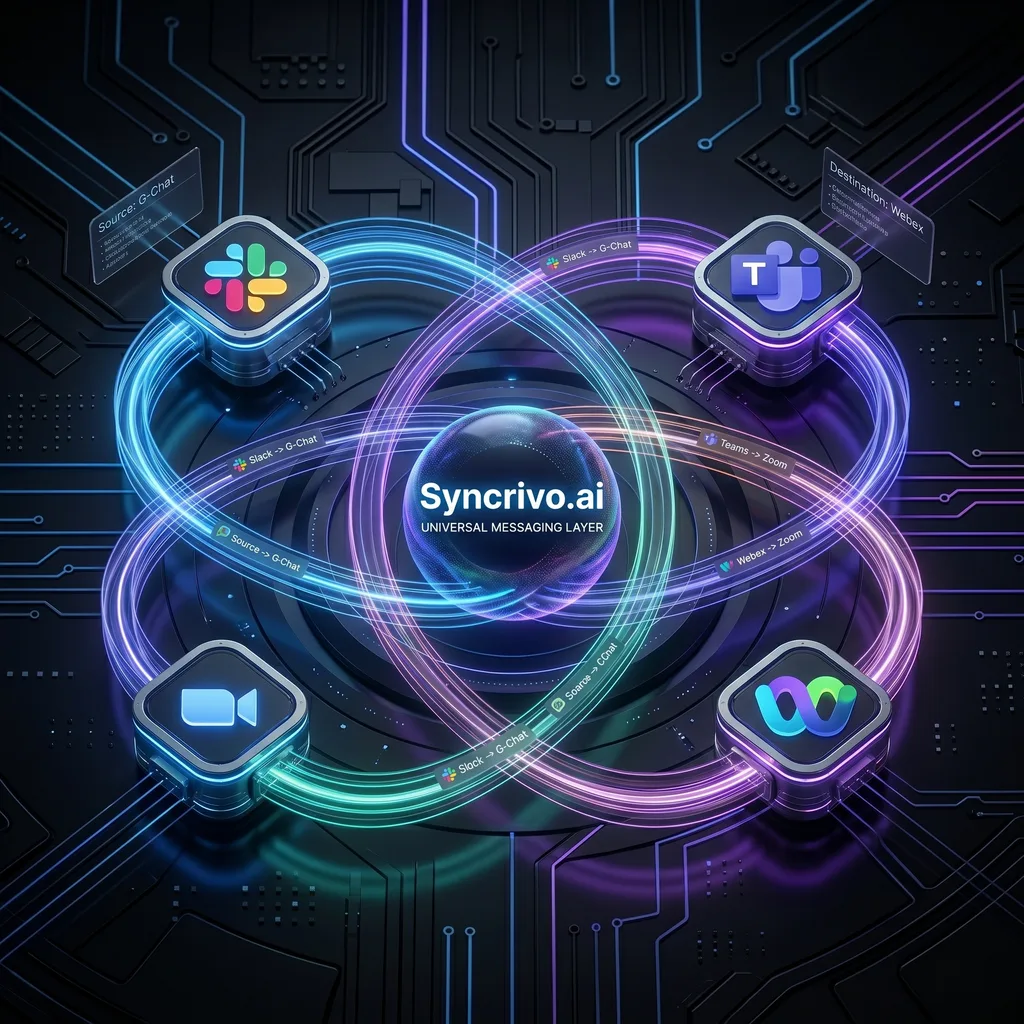
Défis de la Diversité des Plateformes
Les vraies entreprises exécutent plusieurs plateformes — faites-les travailler ensemble
Croissance Organique Multi-Plateforme
Différents départements, régions ou sociétés acquises utilisent différentes plateformes. Forcer la standardisation est politiquement impossible et opérationnellement perturbateur.
SyncRivo permet une coexistence pacifique. Teams, Slack et Google Chat fonctionnent ensemble de manière transparente — chaque équipe conserve son outil préféré.
Collaboration Inter-Plateforme
Les projets nécessitant une collaboration au-delà des frontières de la plateforme échouent. Transfert manuel, messages manqués et fils rompus tuent la productivité.
La synchronisation bidirectionnelle des messages crée des canaux unifiés virtuels. Le contexte du fil, les réactions et les partages de fichiers circulent naturellement entre les plateformes.
Stratégie de Migration Progressive
Les migrations de plateforme en bloc échouent. Les utilisateurs résistent, la productivité chute et le Shadow IT émerge. Vous avez besoin d'une approche progressive à faible risque.
Utilisez SyncRivo comme pont de migration. Les équipes peuvent changer de plateforme à leur propre rythme tout en maintenant une collaboration complète avec les équipes qui n'ont pas encore migré.
L'avantage SyncRivo
Secure Routing Layer
Messages are encrypted in transit (TLS) and message content is not stored on the normal relay path — only message IDs are kept to sync threads, edits and reactions.
Identité d'entreprise et synchronisation d'annuaire
Directory sync on Slack, Microsoft Teams, Google Chat, Webex and Zoom Team Chat, so mentions and sender names stay consistent across platforms.
Governance & Activity Logs
Activity log and security event history (JSON export), per-connection admin switches and owner/admin/member roles. BAA available for Enterprise customers; DPA and sub-processor list available.
Titre
Sous-titre
Couche 1
- Microsoft Teams
- Slack Enterprise Grid
- Google Workspace
- Zoom Team Chat
Couche2
- Directory Sync (all 5 platforms)
- Email Matching
- Mention Resolution
Couche 3
- Message Transformation
- File Relay
- Reaction Sync (not on Webex)
- Edit & Delete Sync
Couche4
- No Message Storage on Relay Path
- Encrypted OAuth Tokens
- US Hosting (us-central1)
Histoires de Succès Hybrides
Comment les organisations embrassent la réalité multi-plateforme
L'Ingénierie Utilise Slack, Tout le Monde Teams
Laissez l'ingénierie conserver la productivité Slack tout en se synchronisant avec les ventes, le marketing et la direction sur Teams.
Différences Régionales de Plateforme
APAC sur Google Chat, EMEA sur Teams, Amériques sur Slack — tous collaborant comme une seule organisation mondiale.
Consolidation de Plateforme par Phases
Migrez département par département sur 2 ans tout en maintenant la collaboration tout au long de la transition.
Sélection des Meilleurs Outils
Choisissez la bonne plateforme pour chaque cas d'utilisation sans sacrifier la communication unifiée.
Common Questions
Multi-platform messaging coexistence is the practice of letting employees on different enterprise messaging platforms — Slack, Microsoft Teams, Google Chat, Zoom Team Chat, or Cisco Webex — communicate with each other in real time, in their native applications, without migrating any team to a single platform. Instead of consolidating everyone onto one tool (a long IT project that disrupts daily operations), coexistence lets each team keep its preferred platform while SyncRivo bridges messages, thread replies, edits, deletions, and file attachments bidirectionally at the channel level. Coexistence is most common after mergers and acquisitions, when corporate teams use one platform and frontline or external workers use another, or when engineering and operations have made independent platform choices that the business does not want to forcibly reverse.
Indefinitely. Organizations can run multi-platform environments as a permanent operating model — engineering on Slack, sales operations on Microsoft Teams, executive leadership on Google Chat, external partners on Webex — and never consolidate. SyncRivo is engineered for long-term coexistence, not as a temporary bridge during migration: channel mappings can be added, modified, or retired in the dashboard without redeploying anything. The coexistence model also adapts as the organization changes — when a new department adopts a different platform after an acquisition, or a partner migrates from Slack to Teams, the existing bridges keep working and new ones are added rather than starting another platform-consolidation project. Bridges can be disabled or deleted in the dashboard at any time without data-extraction work, because messages already live natively on each platform.
Yes. SyncRivo supports all five major enterprise messaging platforms simultaneously: Slack, Microsoft Teams, Zoom Team Chat, Cisco Webex, and Google Chat. A single channel bridge can fan messages across all five platforms at once — so a message posted in a Slack channel appears in the mapped Teams channel, Google Chat space, Webex room, and Zoom Team Chat channel in real time — typically within seconds — with thread replies routed back to the correct thread context in each platform. Enterprises can run point-to-point pairs or connect one channel to several others at once (N-way). Threads, @mentions, file attachments, edits, and deletions are preserved across bridged platforms (mentions become real mentions when the person is in the synced directory, otherwise plain text); emoji reactions sync on Slack and Google Chat, with limits on Teams and Zoom, and are not yet supported on Webex. Echo prevention and message-pair tracking are handled by a stateful sync engine, not a stateless trigger-action loop, which is what keeps three-way and five-way bridges from producing duplicate or recursive message delivery.
SyncRivo is a single Enterprise plan with custom pricing that connects all five platforms and runs alongside your existing licensing without a rip-and-replace. A forced platform migration carries costs for parallel platform licensing during transition, IT and change-management labor, end-user retraining, lost productivity during the cutover, and the cost of integrations that need to be rebuilt on the new platform. Migrations also take many months end-to-end. Coexistence avoids those costs: the first channel bridge is typically live during onboarding, once your Slack/Teams admins approve the app, with no end-user retraining, no integration rework, and no migration weekend. SyncRivo's ROI calculator quantifies the specific payback period for your organization based on headcount, current platform mix, monthly channel volume, and the per-seat licensing cost of the platforms you would otherwise need to consolidate.
SyncRivo's Enterprise plan is designed for multi-platform deployments, with owner/admin/member roles, per-connection admin switches, directory sync on all five platforms, Google sign-in with optional MFA (SAML SSO is on the roadmap), and hosting in the US (Google Cloud us-central1). No Active Directory federation, DNS changes, or firewall rule updates are required — the bridges connect via OAuth at the application layer, once your platform admins approve the app. Messages can show the original sender's name and avatar; Slack still shows an APP label, and in Teams channels the post comes from the SyncRivo app with the sender's name. Discuss your scale and rollout plan with us during a demo.
Related integration guides
Ready to connect? Slack ↔ Teams connection setup →
Prêt à transformer votre communication d'entreprise ?
Connectez-vous avec notre équipe d'entreprise pour discuter de vos besoins spécifiques et voir SyncRivo en action.