Day 1 Connectivity Without the Migration Headache
Stop forcing acquired teams to switch platforms immediately. Bridge Microsoft Teams, Slack, and Google Chat across tenants to realize deal value while you plan the long-term migration.
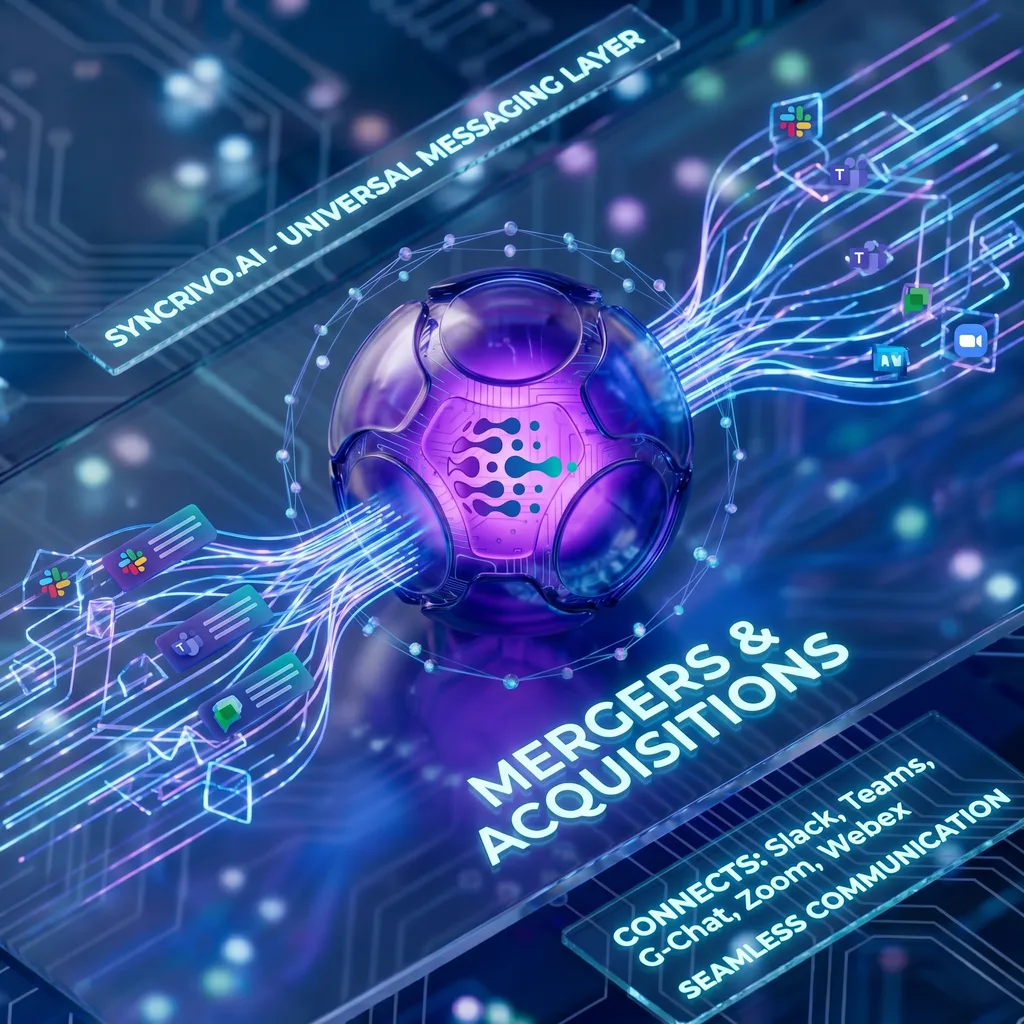
The M&A IT Paradox
Deal speed vs. IT reality.
The "Rip and Replace" Trap
Traditional M&A IT playbooks demand you migrate the acquired company's users from Google Workspace to Microsoft 365 immediately. This hurts productivity and risks talent attrition.
Stop migrating. Start federating. SyncRivo connects their Google Chat to your Microsoft Teams once both admins approve the app, allowing "Day 1" collaboration without a single mailbox migration.
Identity & Directory Fragmentation
Employees in the new subsidiary don't show up in your GAL (Global Address List). They can't share files, view calendars, or message your core teams.
SyncRivo's directory sync maps users across tenants. With a partner connection in place, people search in Teams can find "John from Acme Corp" even if he's actually on Slack in a different domain.
Security Blindspots
During integration, users resort to shadow IT (WhatsApp, personal Gmail) to talk to their new colleagues because official channels are blocked.
Bring communication back onto approved platforms. Bridged messages land natively in each tenant, where that platform's own DLP and retention policies apply.
The SyncRivo Advantage
Secure Routing Layer
Messages are encrypted in transit (TLS) and message content is not stored on the normal relay path — only message IDs are kept to sync threads, edits and reactions.
Enterprise Identity & Directory Sync
Directory sync on Slack, Microsoft Teams, Google Chat, Webex and Zoom Team Chat, so mentions and sender names stay consistent across platforms.
Governance & Activity Logs
Activity log and security event history (JSON export), per-connection admin switches and owner/admin/member roles. BAA available for Enterprise customers; DPA and sub-processor list available.
Tenant-to-Tenant Bridging
Connect separate tenants without establishing bidirectional domain trusts or opening firewalls.
Acquirer Environment
- Entra ID Primary
- Microsoft Teams
- Corporate Governance
SyncRivo Federation Layer
- Directory Sync
- Partner Connections
- Per-Connection Admin Switches
Acquired Entity
- Google Workspace
- Slack
- Existing Channels
Accelerate Deal Value
From Due Diligence to Day 1 and final integration.
Private Equity "Operating System"
PE firms can bridge communication across portfolio companies, enabling shared services centers without merging tenants.
Reverse Takeovers
When a modern tech firm (Slack-heavy) acquires a legacy competitor (Teams-heavy), use SyncRivo to keep the innovators happy while integrating the business.
Divestitures & Carve-Outs
Spinning off a business unit? Keep them connected to parent services during the TSA (Transition Service Agreement) period, then sever the link cleanly.
Joint Venture Security
Create a "Demilitarized Zone" (DMZ) for two competing firms working on a joint venture. Only the channels you choose are bridged.
Why M&A IT Integrations Miss Day 1 Targets
Communication breakdown is a common problem in the first months after a deal closes. Traditional IT playbooks demand platform migration before people can collaborate — a sequencing problem that creates months of productivity loss, shadow IT, and talent attrition.
The root cause is a false assumption: that "integration" must mean "migration." The SyncRivo model inverts this. You federate first — enabling Day 1 collaboration without moving a single mailbox or user account — and migrate on your own timeline, if at all.
Cross-tenant messaging (traditional)
Cross-tenant messaging with SyncRivo
IT work (traditional AD trust setup)
IT work with SyncRivo
What Day 1 Setup Actually Looks Like
SyncRivo's dashboard guides your IT team through cross-tenant bridging, with a guided pilot during onboarding. Here's what the typical flow looks like for a Teams-to-Slack bridge:
- 1
Authorize both tenants
An IT admin from each organization completes OAuth2 authorization in the SyncRivo dashboard. No shared credentials, no firewall exceptions, no DNS changes.
- 2
Map channels or spaces
Select which Teams channels should sync with which Slack channels. Granular — you can bridge a single #project-alpha channel without exposing your entire org.
- 3
Set connection controls
Choose per-connection switches for attachments, reactions, in-place edits and deletes, and showing the sender's name. Each platform's own DLP and retention policies continue to apply.
- 4
Pilot with a test group
Invite 5–10 users from each side. Validate message fidelity, file sharing, and @mention resolution before rolling out to the broader organization.
- 5
Roll out to the organization
Enable federation for all mapped users. Users keep working in their own app; full-fidelity features such as Teams reactions or native sender attribution may ask individual users to connect their account.
Compliance Considerations for Regulated-Industry M&A
In healthcare, financial services, and government contracting, M&A communication bridges must satisfy regulators on both sides of the deal. Here is what SyncRivo provides today:
- BAA available for Enterprise customers. Message content is not stored on the normal relay path.
- Security review — SyncRivo does not currently hold a SOC 2 report; we provide a security questionnaire and architecture review on request.
- Native retention — bridged messages land natively in each platform, so your existing eDiscovery tools (Microsoft Purview, Google Vault) cover them. SyncRivo adds an activity log and security event history (JSON export).
- Hosting — SyncRivo is hosted in the US (Google Cloud us-central1). There is no EU-only processing; a DPA and sub-processor list are available.
M&A Integration FAQ
Common questions from IT leaders evaluating SyncRivo for post-merger communication integration.
The first channel bridge is typically live during onboarding, once your Slack/Teams admins approve the app. Unlike traditional domain federation — which can take 4 to 12 weeks because it requires Active Directory trust relationships, DNS modifications, firewall rule changes, and security review on both sides — SyncRivo connects entirely at the application layer through OAuth, so no infrastructure changes are needed in either tenant. Your IT team can initiate the connection from the SyncRivo dashboard with no downtime or maintenance window; the acquired company's admins approve the app on their side. This matters during M&A because business stakeholders typically expect cross-company communication on Day 1, well before any longer-term platform consolidation decision is made.
Yes. SyncRivo provides fully bidirectional sync between Microsoft Teams and Slack — messages sent in a Teams channel appear in the mapped Slack channel in real time, typically within seconds, and vice versa. Threaded replies, @mentions, file attachments, message edits, and message deletions are all preserved across the bridge: a deleted Slack message is also removed from the Teams channel, and a thread reply lands in the correct thread context rather than as a top-level message. Reactions sync with limits: on Teams, reactions appear only for users who connected their account, and Teams supports a small set of reaction types. Messages show the original sender's name and avatar; in Teams channels the post comes from the SyncRivo app with the sender's name, and Slack shows an APP label.
SyncRivo does not run its own DLP or content inspection. Bridged messages are delivered natively to the destination platform, where that platform's DLP and retention policies apply. Message content is not stored on the normal relay path; an optional retry queue temporarily holds undelivered messages. For HIPAA-covered entities, a BAA is available for Enterprise customers. SyncRivo is hosted in the US (Google Cloud us-central1); there is no EU or APAC data residency, and a DPA and sub-processor list are available. SyncRivo does not currently hold a SOC 2 report; we provide a security questionnaire and architecture review on request, plus an activity log and security event history (JSON export).
Bridges can be disabled or deleted from the SyncRivo dashboard with no data-extraction work, because messages already live natively on each platform. As teams migrate in waves, you can keep the bridge running for the channels that still span both platforms and retire each bridge once the last group has moved.
Yes. SyncRivo supports multi-party federation across all five major enterprise messaging platforms simultaneously — Slack, Microsoft Teams, Google Chat, Zoom Team Chat, and Cisco Webex — which is particularly useful for private equity firms managing a portfolio of acquired companies on different chat platforms, or for serial acquirers integrating multiple targets in parallel. You can create dedicated "shared channel" topologies that connect specific teams across tenants — for example, a CFO group spanning four portfolio companies — without opening broad access between organizations or merging directories. Each bridge is scoped to specific channels and managed by owner/admin roles, so a SyncRivo connection between two tenants does not grant any platform-wide access. Bridges between portfolio companies can be added, modified, and retired independently as the portfolio composition changes through new acquisitions or divestitures, without affecting the existing bridges.
Related Resources
Ready to connect? Slack ↔ Teams connection setup →
Ready for Day 1?
Book a demo for a guided cross-tenant pilot. No complex AD trusts required.