无妥协的多平台共存
为企业同步 Microsoft Teams、Slack 和 Google Chat。在不打乱用户工作流、不强制迁移的情况下消除孤岛和影子 IT。
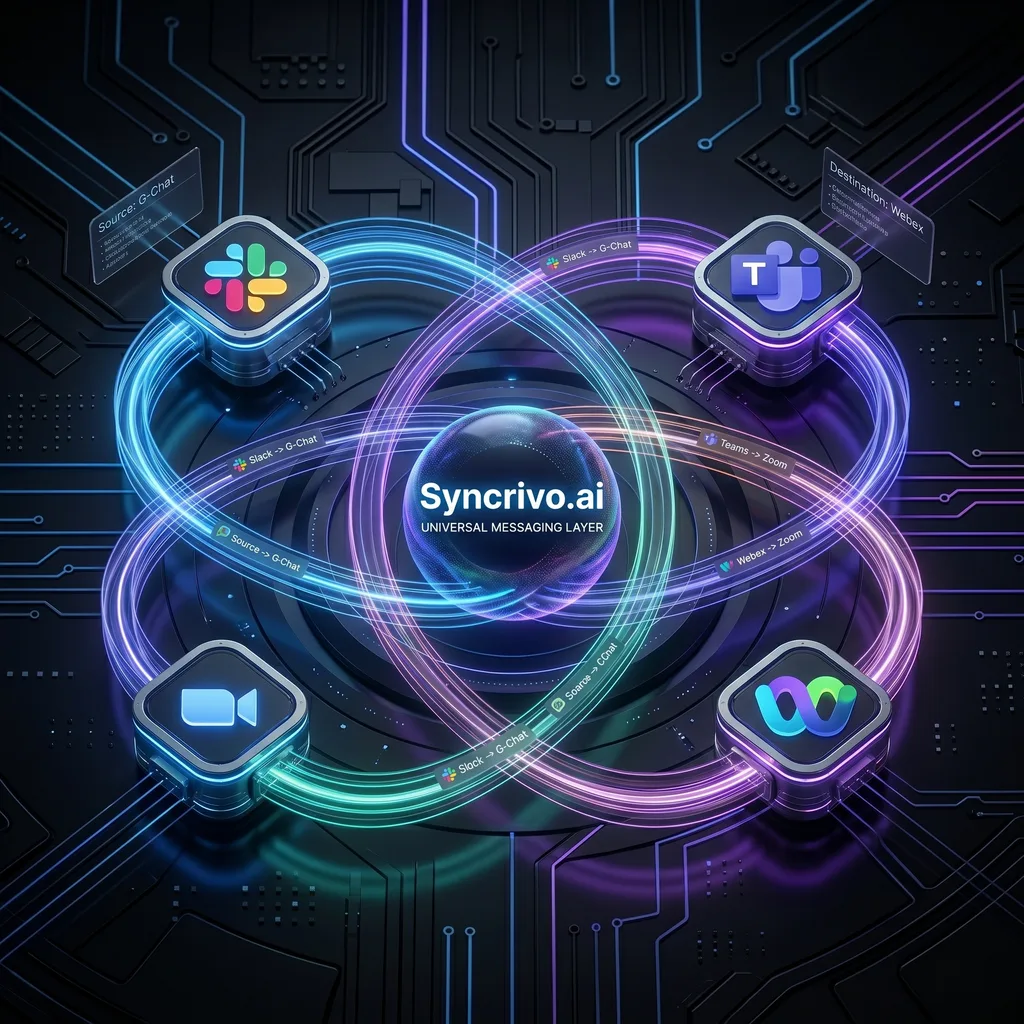
平台多样性挑战
真正的企业运行多个平台——让它们协同工作
有机多平台增长
不同部门、地区或收购公司使用不同的平台。强制标准化在政治上是不可能的,在操作上是破坏性的。
SyncRivo 实现和平共处。Teams、Slack 和 Google Chat 无缝协同工作——每个团队保留他们喜欢的工具。
跨平台协作
需要跨平台边界协作的项目会失败。手动转发、丢失消息和断开的线程会扼杀生产力。
双向消息同步创建虚拟统一频道。线程上下文、反应和文件共享在平台之间自然流转。
渐进式迁移策略
大规模平台迁移会失败。用户抵制,生产力下降,影子 IT 出现。您需要一种渐进的、低风险的方法。
使用 SyncRivo 作为迁移桥梁。团队可以按照自己的节奏切换平台,同时与尚未迁移的团队保持全面协作。
SyncRivo 优势
Secure Routing Layer
Messages are encrypted in transit (TLS) and message content is not stored on the normal relay path — only message IDs are kept to sync threads, edits and reactions.
企业身份与目录同步
Directory sync on Slack, Microsoft Teams, Google Chat, Webex and Zoom Team Chat, so mentions and sender names stay consistent across platforms.
Governance & Activity Logs
Activity log and security event history (JSON export), per-connection admin switches and owner/admin/member roles. BAA available for Enterprise customers; DPA and sub-processor list available.
标题
字幕
第1层
- Microsoft Teams
- Slack Enterprise Grid
- Google Workspace
- Zoom Team Chat
第2层
- Directory Sync (all 5 platforms)
- Email Matching
- Mention Resolution
第三层
- Message Transformation
- File Relay
- Reaction Sync (not on Webex)
- Edit & Delete Sync
第四层
- No Message Storage on Relay Path
- Encrypted OAuth Tokens
- US Hosting (us-central1)
混合成功案例
组织如何拥抱多平台现实
工程部使用 Slack,其他人都使用 Teams
让工程部保持 Slack 生产力,同时与 Teams 上的销售、营销和领导层同步。
区域平台差异
亚太地区使用 Google Chat,欧洲中东非洲使用 Teams,美洲使用 Slack——作为一个全球组织进行协作。
分阶段平台整合
在 2 年内逐个部门迁移,同时在整个过渡期间保持协作。
最佳工具选择
为每个用例选择合适的平台,而不牺牲统一通信。
Common Questions
Multi-platform messaging coexistence is the practice of letting employees on different enterprise messaging platforms — Slack, Microsoft Teams, Google Chat, Zoom Team Chat, or Cisco Webex — communicate with each other in real time, in their native applications, without migrating any team to a single platform. Instead of consolidating everyone onto one tool (a long IT project that disrupts daily operations), coexistence lets each team keep its preferred platform while SyncRivo bridges messages, thread replies, edits, deletions, and file attachments bidirectionally at the channel level. Coexistence is most common after mergers and acquisitions, when corporate teams use one platform and frontline or external workers use another, or when engineering and operations have made independent platform choices that the business does not want to forcibly reverse.
Indefinitely. Organizations can run multi-platform environments as a permanent operating model — engineering on Slack, sales operations on Microsoft Teams, executive leadership on Google Chat, external partners on Webex — and never consolidate. SyncRivo is engineered for long-term coexistence, not as a temporary bridge during migration: channel mappings can be added, modified, or retired in the dashboard without redeploying anything. The coexistence model also adapts as the organization changes — when a new department adopts a different platform after an acquisition, or a partner migrates from Slack to Teams, the existing bridges keep working and new ones are added rather than starting another platform-consolidation project. Bridges can be disabled or deleted in the dashboard at any time without data-extraction work, because messages already live natively on each platform.
Yes. SyncRivo supports all five major enterprise messaging platforms simultaneously: Slack, Microsoft Teams, Zoom Team Chat, Cisco Webex, and Google Chat. A single channel bridge can fan messages across all five platforms at once — so a message posted in a Slack channel appears in the mapped Teams channel, Google Chat space, Webex room, and Zoom Team Chat channel in real time — typically within seconds — with thread replies routed back to the correct thread context in each platform. Enterprises can run point-to-point pairs or connect one channel to several others at once (N-way). Threads, @mentions, file attachments, edits, and deletions are preserved across bridged platforms (mentions become real mentions when the person is in the synced directory, otherwise plain text); emoji reactions sync on Slack and Google Chat, with limits on Teams and Zoom, and are not yet supported on Webex. Echo prevention and message-pair tracking are handled by a stateful sync engine, not a stateless trigger-action loop, which is what keeps three-way and five-way bridges from producing duplicate or recursive message delivery.
SyncRivo is a single Enterprise plan with custom pricing that connects all five platforms and runs alongside your existing licensing without a rip-and-replace. A forced platform migration carries costs for parallel platform licensing during transition, IT and change-management labor, end-user retraining, lost productivity during the cutover, and the cost of integrations that need to be rebuilt on the new platform. Migrations also take many months end-to-end. Coexistence avoids those costs: the first channel bridge is typically live during onboarding, once your Slack/Teams admins approve the app, with no end-user retraining, no integration rework, and no migration weekend. SyncRivo's ROI calculator quantifies the specific payback period for your organization based on headcount, current platform mix, monthly channel volume, and the per-seat licensing cost of the platforms you would otherwise need to consolidate.
SyncRivo's Enterprise plan is designed for multi-platform deployments, with owner/admin/member roles, per-connection admin switches, directory sync on all five platforms, Google sign-in with optional MFA (SAML SSO is on the roadmap), and hosting in the US (Google Cloud us-central1). No Active Directory federation, DNS changes, or firewall rule updates are required — the bridges connect via OAuth at the application layer, once your platform admins approve the app. Messages can show the original sender's name and avatar; Slack still shows an APP label, and in Teams channels the post comes from the SyncRivo app with the sender's name. Discuss your scale and rollout plan with us during a demo.
Related integration guides
Ready to connect? Slack ↔ Teams connection setup →
准备好改变您的企业通信了吗?
与我们的企业团队联系,讨论您的具体要求并查看 SyncRivo 的实际应用。